


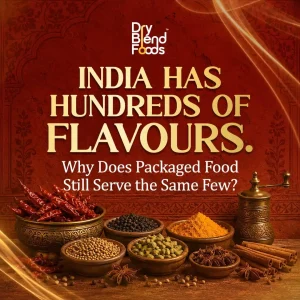
Walk down any supermarket aisle in India and the flavour options on the shelf rarely reflect what is being cooked at home two streets away. Masala chips run through three or four familiar avatars. Sauces cycle between tomato, mint and tangy masala. Seasoned snacks lean on a shortlist of crowd-pleasers that could sit on a shelf in almost any state. Yet the country’s actual flavour vocabulary runs into the hundreds: mustard-forward Bengali profiles, tamarind and curry leaf notes from the south, smoked and fermented flavours from the Northeast, saffron-led warmth from the Kashmir valley, and dozens more that rarely travel beyond their region of origin.
Industry insiders describing India’s food landscape put it plainly: the country isn’t one market, it is closer to twenty, each with a distinct palate and spice tolerance. Global culinary forecasts are now naming individual Indian regions such as Goa, Nagaland and the Himalayan belt as standalone flavour identities worth tracking, alongside established movements like Korean and Middle Eastern cuisine. The recognition is arriving from outside the country faster than it is reaching packaged shelves within it. So why does the shelf lag so far behind the plate?
The honest answer sits in operations, not appetite. Bringing a regional flavour to a packaged format at national or multi-city scale means solving problems a home cook never has to: sourcing the same spice profile consistently across harvest seasons, holding flavour intensity steady across production runs, and keeping shelf life and food safety intact, all without ballooning SKU counts or vendor complexity. Quick-service chains that have gone down the regional route describe exactly this discipline: centralised spice blends, audited vendors, temperature-controlled supply chains and strict portion control, sitting quietly behind a menu item that reads as effortlessly local. A regional dish built for one city has to taste identical whether it is served in Chennai or Bengaluru, and that consistency is engineered, not assumed.
Building that discipline for one flavour is manageable. Doing it for a dozen regional variants, each with its own sourcing quirks, is where teams retreat to the safety of three or four flavours that are already proven and already stable on the line.
The irony is that global flavour science is moving the other way. As consumers grow more literate about regional cuisines through travel and social platforms, demand is moving away from generic fusion and toward hyper-specific regional authenticity, with flavour houses across Asia reviving hyper-local ingredients in modern formats rather than flattening them into generic regional labels. The constraint was never whether consumers want a Chettinad pepper note or a Kolkata-style tangy finish. It has been whether a manufacturer can deliver that note reliably, batch after batch, without rebuilding its sourcing pipeline each time.
This is exactly the translation work a formulation partner exists to do. A regional flavour profile, once studied and codified, can be engineered into a stable dry blend, seasoning or premix that behaves the same way on a production line as it does on a development bench. Spice ratios that would vary by harvest, vendor and season become fixed, repeatable inputs, whether the format is a bakery mix carrying a regional spice note, a beverage premix built around a specific chai profile, or a marinade designed for a particular grilling style. What reads to a consumer as a bold regional discovery is, from a food operations standpoint, a carefully engineered blend built to hold its flavour, colour and aroma through storage and transport.
For QSR chains testing Tier 2 and Tier 3 expansion, cloud kitchens building region-specific menus, and manufacturers deciding whether their next SKU should chase the familiar or the genuinely local, the real question isn’t whether India’s flavour diversity is worth pursuing. It clearly is. The question is whether the formulation and sourcing discipline exists to bring it to shelf without disrupting everything else that already works.
Dry Blend Foods works with food manufacturers, QSR operators and hypermarket private labels on precisely that problem: turning a specific regional flavour brief into a seasoning, marinade or premix that performs consistently at scale. For teams weighing which regional note to develop next, a conversation with the formulation team is often the fastest way to find out what’s operationally possible. Reach out at sales@dryblendfoods.com to start one.
