


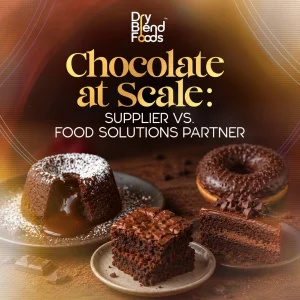
Cocoa pricing has stopped behaving like a predictable input, and the businesses formulating through that volatility are pulling ahead of those simply absorbing it. Here is what actually separates a chocolate supplier from a formulation partner, and why the distinction now shows up directly on the production line.
Cocoa has stopped behaving like a stable input. Prices have swung through historic highs and sharp corrections within eighteen months, and every QSR chain, bakery group, and dessert manufacturer running chocolate-based SKUs has felt it somewhere in the P&L. The easy reaction is to treat this as a sourcing problem: find a cheaper supplier, switch origins, renegotiate terms. The harder, more useful question is whether your chocolate partner is built to formulate through volatility, not just supply around it.
That distinction, between a supplier and a formulation partner, is becoming the real competitive line in B2B chocolate procurement.
Why Chocolate at Scale Is a Formulation Problem, Not a Sourcing Problem
At commercial volume, chocolate is not one ingredient. It is a system of cocoa solids, fat phase, sweeteners, emulsifiers, and flavour carriers, each interacting with the others under specific processing conditions. Enrobing, moulding, baking inclusion, and beverage premixing each stress that system differently.
A supplier sells tonnage against a specification sheet. A formulation partner understands how that specification behaves inside your process, your equipment, and your shelf life targets, and adjusts before failure shows up on the line.
This distinction matters more now than it did three years ago, because cocoa cost pressure is pushing the wider industry toward reformulation: adjusted cocoa percentages, alternative fat systems, and rebuilt flavour profiles designed to protect sensory performance while managing input cost. Getting that right requires formulation depth. Getting it wrong shows up as fat bloom, inconsistent snap, flavour drift, or a product that simply tastes thinner than the one it replaced.
What Separates a Supplier From a Partner
- Application-specific formulation, not generic specification: a chocolate coating built for enrobing behaves differently from one built for a bakery inclusion or a beverage premix. Viscosity, tempering behaviour, and heat stability all need to be engineered for the end use, not assumed to transfer across applications.
- Documented response to cost volatility: When cocoa prices move, the right response is not a silent change to your finished product. A genuine partner brings reformulation options to the table, with the trade-offs clearly explained, before cost pressure forces a reactive decision.
- Process compatibility, validated in advance: Tempering curves, particle size, and fat crystallisation behaviour all need to suit your existing production line. A partner tests for this before delivery, not after the first failed batch.
- Consistency across batches and seasons: Cocoa butter behaviour shifts with origin, season, and processing method. A partner manages that variability upstream so your finished product performs the same way in March as it does in October.
The Compliance Layer Most Procurement Briefs Miss
Chocolate and chocolate-adjacent formulations fall under FSSAI standards governing composition, permitted additives, and labelling, including how compound and couverture-style products must be declared. A formulation that performs well in trial but is not built around these standards creates downstream risk at audit, export clearance, or retail compliance review.
This is where the difference between a transactional supplier relationship and a genuine partnership becomes commercially significant. A partner formulates with compliance built in from the first trial batch, not retrofitted after a regulatory query.
The Right Questions to Ask a Chocolate Ingredient Partner
Rather than benchmarking on price per kilogram alone, food manufacturers and product developers are better served by asking:
- Has this formulation been validated for our specific application? Enrobing, moulding, and inclusion use cases all demand different technical profiles.
- What is the plan if cocoa costs move again? A credible partner should already have reformulation pathways mapped, not be improvising in real time.
- Does the fat system and tempering behaviour suit our existing line? Compatibility testing should happen before delivery, not after a production run.
- Is the formulation FSSAI-compliant by design? Permitted additive levels and labelling accuracy should be built into the specification, not checked retrospectively.
- Can batch-to-batch consistency be demonstrated, not just promised? Ask for data across seasons and origins, not a single sample result.
Formulation Discipline Is the New Differentiator
The chocolate category has moved past a simple commodity conversation. Cost volatility, reformulation pressure, and tightening compliance expectations mean that food businesses scaling chocolate-based products need more than a tonnage contract. They need a partner who treats every formulation as an engineering problem with a commercial consequence.
The Long Road From Supplier to Food Solutions Partner
Dry Blend Foods works with QSR chains, cloud kitchens, HoReCa operators, and food manufacturers to develop chocolate and chocolate-adjacent formulations built for real production conditions: validated for application, engineered for consistency, and compliant by design.
If you are reformulating an existing chocolate line, scaling a new product, or assessing whether your current supplier is built to handle what comes next, get in touch with Dry Blend Foods to discuss your formulation brief. Dry Blend Foods builds chocolate formulations that hold their structure on the line and their standard on the label.
