

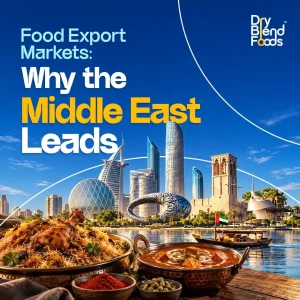
Food Export Markets 2027: Why the Middle East Leads
Every export plan begins with the same decision: which market first. We ran a LinkedIn poll on exactly that, with four options on the table: the Middle East, Europe, Southeast Asia and North America. The Middle East came ahead.
It is a result worth examining rather than simply reporting, because all four are growing and all four are worth holding. The distinction is not scale. It is the standard each market holds a supplier to before it starts buying.
Four markets, four entry conditions
Europe rewards patience. Buyers qualify a supplier before they place an order, and the qualification runs on traceability, documented process control and an auditable history. Entry is deliberate, and the resulting accounts are among the most durable in the industry, because the same rigour that slows the start makes the relationship difficult to displace.
North America rewards sharpness. Buying is consolidated and volumes are substantial, so a supplier who gets specification, consistency and cost position right finds few markets that convert faster. It is a commercial contest more than a regulatory one, decided on how clearly a product earns its place in a category.
Southeast Asia rewards local fluency. Consumption growth is strong and taste profiles move quickly, while registration and labelling regimes differ from one country to the next. Suppliers who build market by market rather than treating the region as one block compound a real advantage over time.
The Middle East rewards readiness. That is why it leads this vote, and the reasoning behind it is worth setting out properly.
Why the Gulf leads: demand that does not move
Import dependence across the Gulf Cooperation Council is structural rather than cyclical. Demand follows population, tourism and retail expansion rather than harvest cycles, which makes it one of the few food markets that can be forecast with reasonable confidence. GCC agri-food and seafood imports have grown by around 6.7 percent a year since 2020.
India is already the largest supplier into that market, holding a 12.6 percent share of GCC agri-food and seafood imports in 2024, growing faster than the market itself and sitting ahead of Brazil and the United States. The GCC is India’s largest trading bloc, with bilateral trade of US$178.56 billion in the 2024-25 financial year, and both sides signed a joint statement in February 2026 to advance free trade agreement negotiations. The India-UAE comprehensive economic partnership agreement has applied since 2022.
For an Indian manufacturer, that combination is unusual. Demand is dependable, the trade relationship is established, and the regulatory framework is harmonised enough through shared Gulf standards that compliance work completed for one market carries substantially into the next. Gulf ports also re-export into neighbouring markets, so one well-chosen distributor relationship reaches further than the map suggests.
Demand, in other words, is the stable part. Through 2026, the variable has been delivery.
The variable is delivery, not demand
Shipping routes into the Gulf have been disrupted for much of 2026. Carriers have applied risk and congestion surcharges on Gulf-linked lanes, some cargo has been rerouted through alternative ports, and transit times have been difficult to forecast from one booking to the next. Conditions have changed within days more than once, so the only reliable position is the one a freight forwarder confirms in the week you book.
The commercial consequence matters more than the detail. Procurement teams have lengthened planning horizons, widened supplier rosters, and started treating complete documentation as a competitive advantage rather than an administrative courtesy. Price still decides contracts. Reliability now decides who is invited to quote.
Product format matters here too. Dry blends, seasonings and premixes are ambient, lightweight and shelf-stable, which makes them well suited to buffer stock held in Gulf warehouses, separating customer delivery from vessel schedules.
What the Gulf asks in return
Precision, and no tolerance for approximation. Four areas decide whether a consignment moves or sits.
Halal certification
Halal certification is the entry condition, and it must come from a body the importing authority recognises rather than one the exporter prefers. The United Arab Emirates requires certificates from bodies registered with its Ministry of Industry and Advanced Technology. Saudi Arabia works from its own recognised list, and a certificate from an unrecognised body can mean suspended clearance or goods returned to the port of origin. Recognition is country by country, so confirm it for each target market, and make sure the product list on the certificate matches what is actually on the shipment.
Arabic labelling
Prepackaged food labelling across the Gulf follows a common regional standard. Labels must carry Arabic, either as the label language or as a translation alongside it, covering the product name, ingredient declaration, date marking and country of origin in the prescribed form. Finalise artwork before production rather than after. Relabelling in a bonded warehouse costs time that a disrupted shipping year does not give back.
Shelf life
Shelf life is governed by product category rather than by the manufacturer alone, and expiry dating follows the same regional framework. The figure that shapes the commercial relationship is not what the pack declares but what remains when the distributor takes delivery, after production, documentation, sailing time and clearance. Minimum remaining life at delivery varies by country and category. With current transit times, build in headroom.
Documentation
Lead time is a documentation question more than a production one. Certificates of origin and health, halal documentation, laboratory reports and pre-shipment inspection all sit on the critical path, and a missing annexure holds a container as effectively as a missing pallet. Produce the documents alongside the goods, not after dispatch.
Ramadan 2027 and the clock already running
Ramadan 2027 is expected to begin in February, with Eid al-Fitr falling in March, subject to moon sighting. Gulf retail buyers lock their Ramadan ranges months ahead of that, which places those decisions in the current quarter.
Specifications, Arabic label artwork, halal certificate scope and distributor samples need to be settled between now and November. Production and dispatch follow through November and December, with routing and Incoterms agreed alongside them. January is for stocking Gulf warehouses and distributor sell-in, and replenishment during the month itself should be planned before the month begins.
If you are not yet placed for Ramadan 2027, the useful move is to target replenishment, the Eid period and the months that follow, and use the next twelve months to be first in line for 2028, which begins earlier still.
What to ask a manufacturing partner
Choosing the market is the easy half of an export plan. The harder half is finding a manufacturing partner who answers the same questions the same way, consignment after consignment.
Does the halal certificate come from a body recognised in each target country, and does its scope cover every product on the shipment? Are specifications locked, so the eleventh batch matches the first? Is the blend formulated against the storage reality of the destination and the real transit time rather than the origin? Are Arabic labels, date coding and certificates of analysis produced to the destination’s requirements? Is documentation produced alongside the goods rather than chased after dispatch? And can a blend be proven on a trial consignment before volume is committed?
Dry Blend Foods supplies food businesses in international markets worldwide, with established presence spanning Europe, the Middle East and beyond, and holds FSSAI, US FDA, Spices Board of India, AEO (Indian Customs), APEDA and Halal India credentials. With no minimum order quantity, a buyer can prove a blend on a trial consignment before committing to volume.
Talk to us about your 2027 export plan
Wherever 2027 takes your range, the conversation that moves it forward is a specification conversation. Tell us what you are selling and where it is landing, and our team will develop samples against that brief.
sales@dryblendfoods.com | www.dryblendfoods.com
Frequently asked questions
Is halal certification mandatory for food exports to the Gulf?
In practice, yes for most food categories. Certificates must come from a body the importing country recognises, and the United Arab Emirates and Saudi Arabia maintain separate lists. Check recognition for each country and each product category.
Is Arabic labelling compulsory?
Yes. Prepackaged food labels sold in the Gulf must carry Arabic, either as the label language or as a translation alongside it.
When is Ramadan 2027?
Ramadan 2027 is expected to begin in February, with Eid al-Fitr falling in March, subject to moon sighting.
Does compliance for one Gulf country apply to the others?
Partly. GCC states share Gulf standards, so labelling and shelf-life work carries across to a large degree. Halal recognition, product registration and clearance are administered country by country.
