


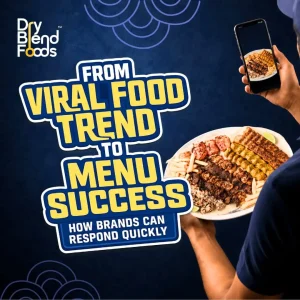
A trend window is shorter than most product development cycles. The brands winning on speed are not moving faster. They have built differently.
A flavour profile catches fire on social media. Within days, QSR chains are discussing whether it belongs on the menu. Cloud kitchen operators are fielding requests from aggregator category teams. Procurement managers are being asked how quickly a brief can become a product.
This pattern is now a structural feature of the food industry, not an anomaly. As platforms accelerate trend cycles and competitive pressure on menu differentiation intensifies, the gap between a trend signal and a launch window has compressed significantly. In some segments, particularly QSR and delivery-first formats, that window can be as short as six to eight weeks.
The brands that consistently land inside that window share one thing. It is not more creative teams or faster approvals. It is formulation and supply chain infrastructure that was built before the brief arrived.
The Real Bottleneck Is Not the Idea
When a trend gains traction, whether it is a regional spice profile, a sauce format, a beverage premix concept, or a marinade built around an emerging flavour, the instinct in most food businesses is to begin with the concept. What should the product taste like? What format does it take? Who is it for?
These are reasonable starting points. But they are not what slows a launch down.
The actual bottleneck is formulation and ingredient readiness. The ability to source, blend, and standardise a flavour system that can be reproduced consistently, at volume, across multiple production runs, is what separates a trend observation from a product in service. Most food businesses do not have that readiness built in-house. The ones that do have built it deliberately, with the right food solutions partners already in place.
Why Speed Without Infrastructure Creates Quality Risk
Speed in food development without the right infrastructure does not produce faster launches. It produces launches that fail quietly. Teams make compromises that seem minor at the time and become expensive later. A readily available base is used instead of a purpose-formulated one. A flavour profile is approximated rather than precisely characterised. The product passes a pilot and behaves differently at scale.
This is a formulation problem, not a production problem. It surfaces in ways that are entirely predictable:
- FSSAI additive permissibility checks and labelling obligations emerge late in the process, when they are most disruptive to timelines
- Sensory outcomes vary batch to batch, particularly in complex spice, seasoning, or dessert mix applications
- Shelf behaviour under ambient distribution conditions does not match what pilot testing indicated
- Product performance under heat, hold, or transit conditions differs from the brief
These are not random failures. They are the predictable consequence of moving fast without the formulation and supply chain foundations that support a credible commercial launch.
What the Fastest-to-Market Food Businesses Have in Common
The food businesses that consistently shorten the gap between trend insight and production-ready launch are not operating differently in the creative or commercial stage. They are operating differently in the preparation stage, long before a specific brief arrives.
They have formulation expertise on call. That means food solutions partners who understand the science behind flavour systems, dry blends, and functional ingredient interactions, not only suppliers who fulfil orders.
They work with pre-validated product platforms. Rather than building every new product from scratch, they adapt established dry blend, seasoning, dessert mix, or beverage premix bases to a new brief. This avoids restarting regulatory validation and quality sign-off cycles from zero on every project.
They treat consistency as a technical requirement, not a quality check. Every component in a formulation has a documented function. Batch-to-batch performance is engineered in from the start. When the same product needs to go through ten production runs for a national QSR rollout, that foundation is what holds.
The result is a development cycle measured in weeks, not months. In a market where trend relevance decays fast, that compression is a meaningful commercial advantage.
Sourcing Readiness Is Part of the Formula
One dimension of launch speed that receives far less attention than formulation is ingredient supply readiness. A well-designed product will still stall if the underlying ingredients carry long lead times, inconsistent availability, or single-source risk.
For food businesses scaling a new product under time pressure, this risk is often underestimated until it materialises. A dry blend or premix solution built on well-sourced, reliably available components removes a significant and often invisible variable from the launch timeline.
It also simplifies procurement substantially. Rather than managing multiple raw ingredient suppliers across a complex flavour system, a single-source formulated solution reduces inbound logistics, quality verification touchpoints, and the exposure that comes from one late delivery affecting an entire launch.
The Infrastructure Question
The brands that respond best to emerging trends are not the ones moving fastest when a brief arrives. They are the ones that built the capacity to respond before the brief existed.
That means documented formulations that are defensible under FSSAI scrutiny and export market requirements. It means solutions designed to perform across the real distribution and food operations conditions they will actually face. It means food solutions partners who can work from a brief and return a production-ready answer in a timeframe that keeps pace with a competitive menu calendar.
When the next brief lands, and in today’s food market it will land sooner than the last one, the question is not whether your team has an idea worth pursuing. The question is whether your formulation and supply chain foundation can support a launch that holds up.
A Food Solutions Partner Built for This
Dry Blend Foods works with QSR chains, HoReCa operators, cloud kitchens, and food manufacturers to develop and supply a full range of food solutions: dry blends, seasonings, spice mixes, dessert mixes, bakery mixes, beverage premixes, marinades, and functional ingredient systems built for production at scale.
Every formulation is built on purpose-selected, fully characterised ingredients, with complete traceability and compliance with FSSAI requirements. The standard is a solution that performs consistently in food operations across every batch, under real-world distribution conditions, from the first production run.
If your team is working against a tight development timeline, expanding a product range, or looking for a food solutions partner who can take a brief all the way to production-ready, get in touch with Dry Blend Foods.
