

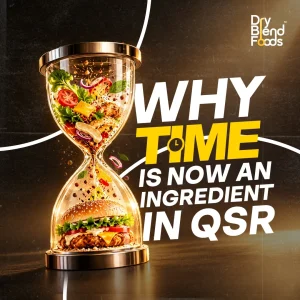
Why Time Is Now an Ingredient in QSR
Every quick service business tracks cost per plate, yield, wastage and margin. Far fewer apply the same discipline to the one input that governs all four. Time.
QSR speed of service is not a dashboard metric. It is throughput, labour cost per transaction and repeat visit frequency, compressed into one number. Among the QSR trends worth attention this year, this is the one that touches every other: time now behaves like an ingredient. Measurable, costly and finite.
The chains pulling ahead are not the ones with the longest menus or the largest teams. They are the ones who know exactly where their minutes go.
Delivery platforms now set the service window
Quick commerce has rewritten what a customer accepts as a reasonable wait. Delivery platforms rank partners on preparation time and penalise delay in visibility, not only in ratings. Drive-thru, counter and delivery each run to a clock the operator does not set.
Speed alone does not settle it. An order that arrives fast and wrong costs more than one a moment later and right: a remake, a refund, a public review, and a customer who stops testing you.
QSR menu development has become a production problem
Limited time offers no longer follow the seasons. They follow the feed. A flavour that trends in one market appears on national menus within a quarter and retires before year end.
For a multi-outlet chain, every launch carries a cost that rarely reaches the costing sheet: new raw lines to source and audit, new specifications to write, training hours multiplied by every site and every roster. A build with fourteen components is not a recipe. It is a timetable. Menu velocity is limited less by ideas than by the time to execute them.
Attrition makes complicated recipes fragile
Staff turnover in quick service is among the highest of any employer category, and each exit costs three times over: recruitment, training, and the productivity lost while a new hire comes up to speed.
So you are not training a team once. You are training a rolling population, permanently. Any preparation that rests on individual judgement, seasoning adjusted by eye or a marinade balanced by feel, will be made eleven different ways by eleven different people. That variance costs twice: in wastage, and in the customer who does not come back.
Consistency is what speed usually costs
This is the trade most operations accept quietly. Push the line faster and something slips. Portioning drifts, seasoning gets heavy, sauces separate, the signature item stops tasting like itself in half the outlets.
Speed produced on the floor through pressure is borrowed, and it is repaid in complaints, remakes and ratings. Speed built into the product behaves differently. It holds.
Speed scratch: how the fastest operations build time in
The fastest QSR operations are not working faster. They have moved the complicated part of the process upstream.
That approach is speed scratch: buying flavour already standardised and finishing the dish in your own food operations. Seasonings, bakery mixes, dessert mixes, beverage premixes and marinades perform identically in every batch, at every outlet, in every market.
The craft stays with the culinary team. The repetitive, variance-prone, labour-heavy groundwork moves to a formulation partner equipped to do it at scale. Twelve steps become three. Training time falls. A new launch stops being a multi-week programme and becomes a single order.
Procurement gains too: fewer raw lines, fewer suppliers to audit, fewer quality variables, a shorter path from concept to live service. For quick service restaurant efficiency, that is the difference between scaling a concept and stalling it.
Buying time instead of borrowing it
This is the work Dry Blend Foods does for QSR chains worldwide, alongside HoReCa operators, flight caterers, hypermarkets, cloud food operations and industrial manufacturers. Europe, the Middle East, Southeast Asia and the United States are all established markets, within an export footprint that keeps widening.
Custom seasoning blends for QSR chains are developed at our Innovation Centre in Gurugram, then produced to specification for each market’s taste profile and regulatory requirements. The same applies to our bakery mixes, dessert mixes and beverage premixes.
There is no minimum order quantity. A single-city pilot is handled with the same rigour as a national rollout.
Questions operators ask about speed scratch
What is speed scratch in QSR? Speed scratch means buying standardised components, such as seasonings, marinades or bakery mixes, and finishing the dish in your own food operations. Prep time and variation fall, while final assembly and the signature taste stay in-house.
How does QSR speed of service affect profitability? Faster service raises throughput per hour and lowers labour cost per transaction. Shorter preparation times also improve listing visibility on delivery platforms.
How do custom seasoning blends reduce training time? Ratios are fixed at formulation, so staff no longer balance flavour by eye. A new hire learns one measured step instead of a full method, and the result matches across every roster and outlet.
Can a chain trial a blend before committing to volume? Yes. There is no minimum order quantity, so a blend is trialled in one outlet or one city before any wider rollout.
Before the next launch, count the minutes
Take one high-volume item and count the minutes it consumes before it reaches a customer: sourcing, prepping, blending, training, correcting. The time hides in the stages nobody costs, and that figure decides whether a concept scales or stalls.
If time is the ingredient your margins are quietly paying for, start with one item, not the whole menu. Send us the specification you work to, or describe the result you want on the plate. Our formulation team will develop a matching blend and send a sample to trial in live service. Volumes, lead times and rollout follow from there.
To request a sample or share your QSR requirement, write to sales@dryblendfoods.com or visit www.dryblendfoods.com.
