


Every international food business runs on a quiet assumption. That what was ordered will arrive, on the date it was promised, behaving exactly like the last consignment did.
When that assumption holds, nobody in the business talks about sourcing. When it breaks, nothing else gets discussed.
For any operator working beyond a single market, sourcing is not a procurement line item. It decides whether a launch happens on schedule, whether a menu stays consistent from one country to the next, and whether the customer notices anything at all. The best outcome in global supply is that nobody notices.
That is the standard Dry Blend Foods works to.
Global supply is a discipline, not a claim
Plenty of manufacturers say they export. Far fewer are built for it.
Exporting a single container is a transaction. Supplying a global brand is a commitment that repeats every month, across multiple ports, regulatory environments and internal specifications. It asks for documentation that clears customs without a fortnight of back and forth. It asks for shelf life that survives a longer journey than a domestic one. It asks for packaging that holds up through heat, humidity and handling nobody planned for.
And increasingly, it asks for something harder to put on a datasheet: the ability to keep going when routes are redrawn and the map that worked last quarter no longer applies.
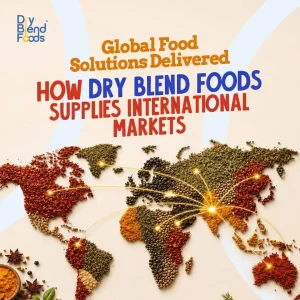
Recent years have not been kind to anyone with a fragile supply chain. Transit times have stretched and freight planning has become a live exercise rather than an annual one. Through all of it, Dry Blend Foods has kept supply moving across African, European and Middle Eastern markets, as well as other international markets and long-standing accounts closer to home.
Continuity of that kind is not luck. It comes from planning inventory ahead of demand, holding buffer stock on fast-moving lines, working with more than one freight partner, and being honest with customers early when a lane looks uncertain. Customers rarely mind an adjusted plan. They mind a surprise.
One partner, an entire product architecture
The other reason international buyers consolidate is range. Managing eleven vendors across four categories is a full-time job nobody was hired to do.
Dry Blend Foods develops and manufactures across the categories that sit at the centre of modern food businesses:
- Seasonings
- Snack seasonings
- Bakery mixes
- Dessert solutions
- Beverage premixes
- Marinades and speed scratch solutions
- Speciality and custom blends developed to a customer’s own brief
For a QSR chain, a cloud kitchens operator, a flight caterer, a hypermarket private label team or an industrial manufacturer, that breadth means one specification conversation instead of six, one quality standard instead of six, and one shipment plan instead of six.
Consistency is the product
Here is what experienced buyers understand and newer ones learn the hard way. In dry blends, the formulation is only half the achievement. The other half is producing it identically on the four hundredth run.
Global customers are buying against a benchmark they have already approved. Every subsequent batch is measured against that memory. Colour, particle size, dispersion, flavour release, performance under the customer’s own process conditions: all of it has to land in the same place, whether the batch is going three hundred kilometres away or three thousand.
Dry Blend Foods manages this through controlled sourcing of raw materials, in-house testing at intake and at finish, retained samples against every production run, and documentation that travels with the consignment rather than following it by email a week later. Compliance requirements differ across markets, and the practical answer is to build to the standard the destination market expects from the outset.
None of this is glamorous. It is exactly what makes long-term supply relationships possible.
Global capability, local responsiveness
There is an assumption that working with an international supplier means slower answers and thinner attention. It is a fair assumption, because it is often true.
The counterweight shows up in the weeks before the shipment, not during it. Sample turnaround that runs in days rather than months. Development teams who read a brief properly and come back with something close, rather than something generic. A named contact who understands the account instead of a shared inbox.
This is where the difference between a supplier and a partner becomes visible. A supplier fulfils an order. A partner asks what the product is trying to achieve, what the target cost looks like, what the plant can actually run, and what the destination market will accept. Then builds accordingly.
Dry Blend Foods works with global brands and national operators alongside each other, and the working method does not change between them. The scale of the order changes. The seriousness does not.
The question worth asking your current supplier
If a product line matters to your business, it deserves a sourcing relationship that can carry it through a difficult quarter, not only an easy one.
So the useful question is not who can quote the sharpest price this month. It is who will still be delivering, on specification and on schedule, when conditions are less forgiving.
If that is a question you are weighing at the moment, we would be glad to take it on with you. Share the brief, the benchmark, or simply the problem you are trying to solve, and our development team will come back with something worth tasting.
Write to us at sales@dryblendfoods.com.
