


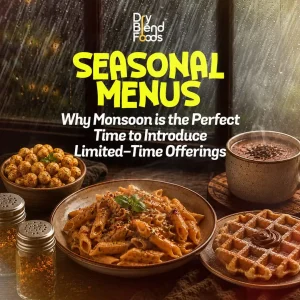
The rain arrives, and so does demand.
Every year, the Indian monsoon does something remarkable to the food service industry: it changes what people want to eat, when they want to eat it, and how much of it they order. For QSR chains, HoReCa operators, and cloud kitchens, this is not a quiet season to endure. It is one of the most commercially interesting windows of the year, and the food operators who understand that are already building for it.
Limited-time offerings (LTOs) are at the heart of that strategy. And monsoon, with its distinct emotional pull and predictable food cravings, gives operators a seasonal canvas that few other periods can match.
Why Seasonality Drives Menu Performance
The total number of limited-time offers across the global food service industry has grown dramatically over the past five years, and the pace has not slowed. This is not a trend driven by novelty. It reflects a structural shift in how food operators manage menus, drive traffic, and compete for attention.
Over half of consumers now factor the availability of limited-time offers into their choice of where to eat. Monsoon gives LTOs something that most seasonal campaigns lack: a genuine emotional and behavioural trigger. The season does not just change the weather. It changes what people crave.
The Monsoon Craving: Real, Predictable, and Commercially Significant
Monsoon consumption patterns are consistent and well-documented. Hot and spiced beverages see clear sales peaks, and demand for comfort-driven snack categories rises as consumers spend more time indoors.
The connection between rain and fried food is not accidental. Reduced sunlight affects mood, and foods high in fat, salt, and carbohydrates provide the dopamine response that the season seems to call for. Pakoras, bhajiyas, samosas, and their regional equivalents become near-compulsive choices across markets. For food service operators, that behavioural pattern is a reliable demand signal that arrives on schedule every year.
On the beverage side, citrus-forward formats, spiced hot drinks, and tropical fruit profiles are all performing strongly in HoReCa and delivery-led formats during the monsoon period. The category opportunity across both snacks and beverages is significant, and it is available to operators who plan for it.
What Makes Monsoon LTOs a Strategic Tool, Not Just a Seasonal Add-On
The commercial case for monsoon LTOs goes beyond riding a craving cycle. Done well, they serve several functions at once.
Testing ground for new SKUs. A monsoon-specific seasoning or beverage premix, introduced as a limited edition, generates real demand data without long-term menu commitment.
Revenue protection during a tricky trading period. Seasonal specials add variety without overcomplicating the core menu. For multi-unit franchise chains, a well-structured LTO also maintains consistency across locations.
Urgency as a commercial lever. Scarcity drives behaviour. A finite window motivates faster trial, particularly in delivery-first formats where promotional cycles are short and menu updates are immediate.
Profitability from familiar formats. When ingredient formats align with seasonal demand, waste reduces, input costs stabilise, and margins hold. The operational lift is lower than most operators expect.
The B2B Dimension: Where Ingredient Partners Matter
For food operators, the success of an LTO does not hinge on the idea alone. It hinges on execution, and execution depends on the ingredient supply chain.
A monsoon special means nothing if the spice blend is inconsistent, the beverage premix requires reformulation mid-season, or the bakery base cannot hold up in high-humidity production conditions. With LTOs, there is no runway for fixing a recipe after launch. Consumers have a limited window to develop familiarity with a new dish, and that window cannot be wasted on quality variance.
This is where a full-scale food solutions partner makes a material difference. A capable B2B partner does not just supply an ingredient. It helps develop the flavour profile, ensures the technical specification works at commercial production volume, and provides the formulation stability that scaled food operations require.
Dry Blend Foods works with QSR chains, cloud kitchens, HoReCa operators, and industrial food manufacturers to develop seasonings, beverage premixes, dessert solutions, and bakery mixes built for exactly this kind of deployment. Formulated for commercial scale. Consistent batch to batch. Adaptable to brief development windows.
The Season Is Already Here
The monsoon window is short, and the operators who make the most of it are the ones with their supply chain and formulations already aligned. If you are planning a limited-time offering for the current or upcoming monsoon season and need a formulation partner to support development, speak to the Dry Blend Foods team at sales@dryblendfoods.com or visit www.dryblendfoods.com.
