


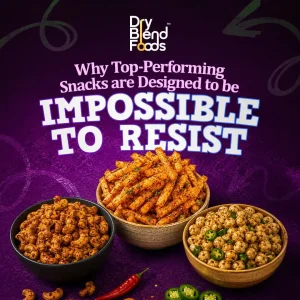
What drives cravability at a formulation level, and why it matters for every product brief
There is a reason the best-selling snacks in any category do not just taste good. They have something harder to name and considerably harder to replicate: a quality that compels the hand back into the pack before the last bite has been swallowed. In product development, that quality is called cravability. And it is not accidental.
Understanding the sensory and neurological mechanisms behind it is one of the clearest advantages a food manufacturer can hold. Because the brands that lead their categories have typically mastered these principles earlier, and built them into product development as a formal objective rather than a hoped-for outcome.
The Bliss Point: Where Pleasure Peaks
In the 1970s, psychophysicist Howard Moskowitz introduced a concept that would reshape how the food industry approaches product development: the bliss point. It describes the precise calibration of sugar, salt, and fat at which consumer enjoyment is maximised and the natural impulse to stop eating is, effectively, overridden.
The goal is not simply to produce a product that tastes good in isolation. It is to position it at the exact intersection of satisfaction and appetite stimulation, where the consumer is neurologically primed to continue before they have made any conscious decision to do so. Products calibrated to this principle consistently outperform on repeat purchase metrics. Those that miss it rarely build the same depth of loyalty, regardless of how strong they score in basic taste trials.
“Cravability is not a hoped-for outcome. It is a formulation objective, and the best-performing snacks treat it as one.”
Texture: The Variable That Decides Everything
Flavour takes the most space in most product briefs. Texture often determines whether a product actually succeeds at shelf.
Research into multisensory food perception consistently shows that the physical and acoustic experience of eating, the crunch, the snap, the specific give of a chew, directly influences how consumers perceive flavour intensity and overall product quality. A crisp that does not deliver the right bite structure reads as stale. A biscuit with the wrong chew signals poor ingredient quality, regardless of what the flavour profile delivers.
Mouthfeel is not a finishing consideration. For many consumers, it is the primary driver of whether a product is worth buying again. Investing in texture engineering at the formulation stage, rather than revisiting it as an afterthought, is one of the clearest differentiators between snacks that plateau and snacks that grow.
Salt, Fat, and Aroma: The Formulation Levers
Salt does considerably more than season. Sodium enhances sweetness, suppresses bitterness, stimulates saliva production, and primes the palate for the next bite before the last has fully registered. In practice, this creates a consumption loop that is genuinely difficult to interrupt, which is precisely why sodium management is a strategic formulation decision as much as a nutritional one.
Fat carries flavour, extends the sensory experience on the palate, and produces the melt-in-the-mouth quality consumers associate with indulgence. Its caloric density also activates deep reward pathways, an evolutionary response that remains highly relevant to how modern consumers experience food, regardless of the format.
Aroma compounds released on opening are equally significant. The olfactory experience precedes eating and begins priming appetite before the first bite has occurred. This effect is not unique to engineered snacks; whole and minimally processed foods behave similarly. What distinguishes well-formulated snack products is the deliberate design of that aroma signal, so that the opening experience itself becomes part of the cravability architecture.
Sensory Complexity and Palate Fatigue
One of the more nuanced tools in snack formulation is contrast: sweet against salty, crunch against soft fill, sharp top notes that resolve into a rounded finish. Contrast sustains consumer engagement across multiple bites by presenting the palate with something slightly new at each stage.
This delays the onset of sensory fatigue, the point at which a flavour becomes predictable and consumption naturally slows. Products with layered, evolving flavour profiles consistently outperform single-note alternatives on pack completion rates. For manufacturers, pack completion is a meaningful and measurable proxy for repurchase intent.
Format, Dissolution, and the Lightness Effect
Puffed and aerated formats present a specific opportunity. Their rapid dissolution in the mouth means consumers frequently underestimate intake, continuing past the point at which denser formats would naturally trigger a pause. Combined with the 15-to-20 minute lag in satiety signalling documented in appetite research, this creates a meaningful consumption window.
Understanding this mechanism is relevant not only to indulgent snack development but to the growing better-for-you segment, where perceived lightness is a core purchase driver and texture must work harder to compensate for reduced fat or sugar. The formulation challenge in both cases is the same: maintaining the sensory conditions that sustain consumption, within whatever nutritional or ingredient parameters apply.
Cravability as a Design Brief
The most commercially successful snacks treat cravability as a product requirement, specified and measured from the earliest development stage. Every element, seasoning architecture, texture profile, aroma design, flavour complexity, and format, is a lever that can be optimised intentionally.
For manufacturers scaling existing lines, launching new SKUs, or reformulating in response to cost or regulatory pressure, getting these levers right from the outset significantly reduces the time and cost of arriving at a product that genuinely performs. The science is not a mystery. It is a methodology, and it is available at the formulation level.
Your Next Winning Snack Starts with Dry Blend Foods
At Dry Blend Foods, our technical team develops seasoning profiles, snack bases, and bakery mixes with cravability built in from the formulation stage. Whether you are scaling an existing line, launching a new SKU, or navigating a reformulation brief, we bring the ingredient science to help your product perform at shelf.
For more insights on related topics, explore our article on: The Science Behind a Great Dry Blend
